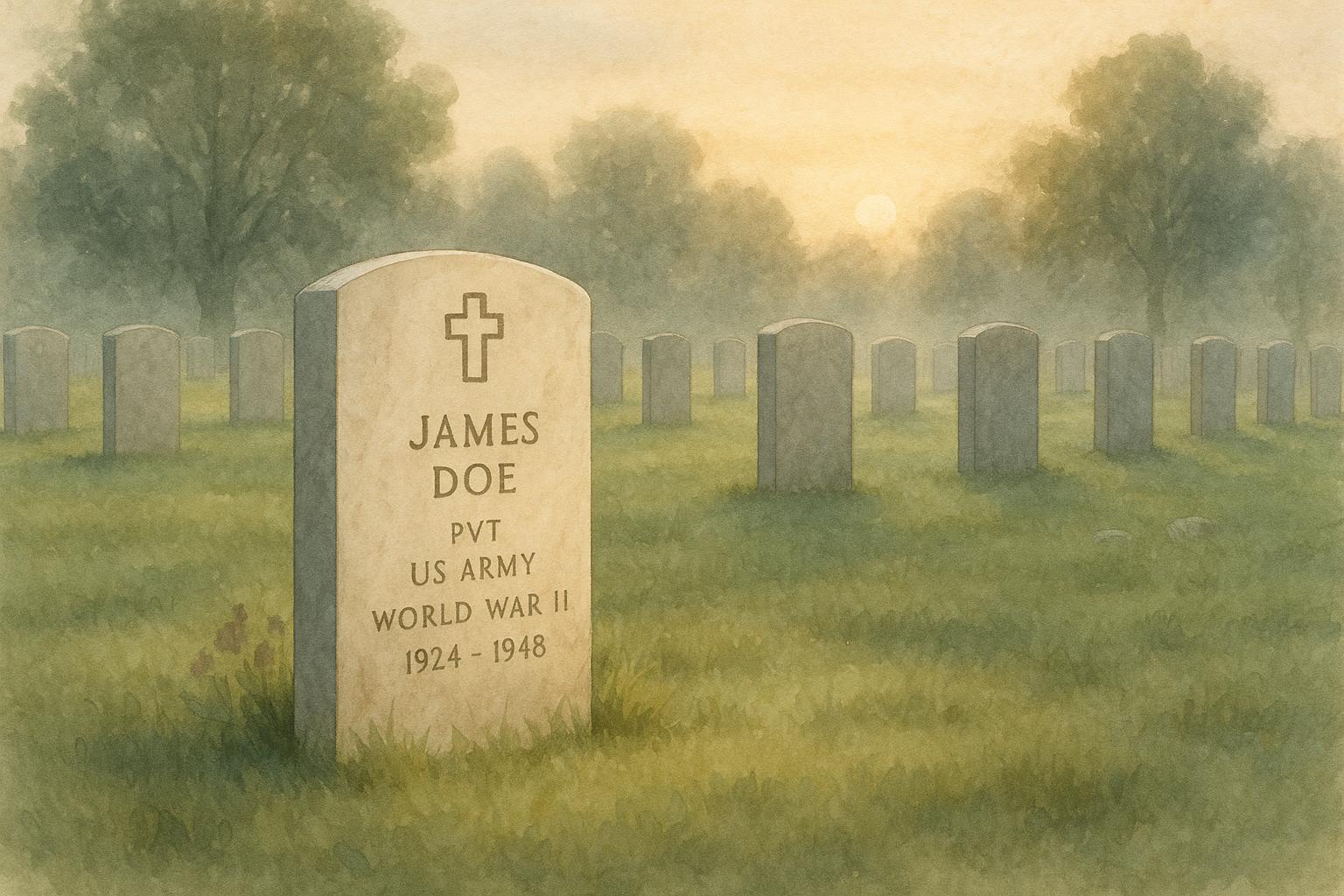
Veterans grave markers honor the service of U.S. Armed Forces members by marking their final resting places with government-provided memorials. These are available for eligible veterans and active-duty members across all military branches, with options for national, state, or private cemeteries. Here’s what you need to know:
- Eligibility: Veterans with honorable or general discharges qualify. Special cases include active-duty deaths, reservists with retired pay, and veterans with unmarked graves (prior to November 1, 1990).
- Marker Types: Choose from upright headstones, flat markers, niche markers, memorial markers (for those without remains), or medallions for private headstones.
- Costs: The VA provides markers and delivery free of charge. Families cover installation fees in private cemeteries.
- Application: Submit VA Form 40-1330 (or 40-1330M for medallions) with the veteran’s DD Form 214 and burial details. National/state cemeteries often handle the process directly.
These markers ensure lasting recognition of a veteran’s service. For detailed guidance on forms, timelines, and customization options, continue reading.
What Are Grave Marker Styles Veterans Get For Free?- Just Give Me 2 Minutes
Who Qualifies for a Veterans Grave Marker?
The Department of Veterans Affairs (VA) has specific rules to determine if a veteran is eligible for a government-provided grave marker. These rules focus on the veteran’s service history, discharge status, and burial details.
Basic Eligibility Requirements
To qualify for a government-provided grave marker, veterans must have been discharged under conditions other than dishonorable. This applies to all branches of the military, regardless of the conflict in which they served.
For those who served after September 7, 1980, the VA requires at least 24 months of continuous active duty. However, exceptions are made for service members who were called to active duty for shorter periods but completed their assigned terms. Veterans who served before September 7, 1980, must meet different criteria and may need additional documentation, such as muster rolls, state military records, pension documents, or land warrants, to verify their service.
Discharges classified as general, honorable, or medical qualify a veteran for this benefit, while dishonorable discharges disqualify them. The date of death also plays a role: for veterans who passed away before November 1, 1990, the VA will only provide a grave marker if the grave is unmarked. For deaths on or after this date, a marker can be issued even if a private marker is already in place.
Special Cases and Exceptions
Some unique circumstances allow veterans to qualify even if they don’t meet the standard requirements. For example, active-duty service members who die while serving are eligible regardless of their length of service. Members of the Reserve or National Guard may qualify if they were entitled to retired pay (or would have been, had they reached age 60) or if they died on active duty or during training. These cases do not require the 24-month service minimum.
Reservists with 20 years of service who have not been on active duty still qualify if they are entitled to military retired pay. The VA also provides markers for veterans whose remains are not recovered or identified, those buried at sea, individuals who donated their remains to science, or cases where cremated remains were scattered.
If a veteran lacks discharge documents, the VA can obtain the necessary records to determine eligibility.
Disqualifying Factors
While many veterans qualify, certain factors can disqualify them. A dishonorable discharge is the primary reason a veteran would be ineligible for a government grave marker. Additionally, the burial location matters – veterans must be buried in established cemeteries. Burial on private land disqualifies the grave from receiving a government marker, although private and local government cemeteries are acceptable for interment.
Spouses and dependents have more restrictive eligibility rules. They are only eligible for VA-provided grave markers if buried in a national or state veterans cemetery. Those interred in private cemeteries do not qualify, although the veteran remains eligible for their own headstone and gravesite.
Lastly, service members who only completed active duty for training do not qualify unless they died while on active duty or meet another qualifying exception.
Types of Veterans Grave Markers
The Department of Veterans Affairs (VA) offers several types of grave markers to honor veterans, tailored to fit different burial settings and cemetery requirements. Understanding these options can help families choose the most fitting tribute for their loved ones.
Headstones and Flat Markers
Upright headstones are the classic, vertical memorials made from durable materials like marble or granite. These stand above ground and offer a prominent, traditional way to honor a veteran.
Flat markers, on the other hand, lie flush with the ground, offering a more uniform and streamlined appearance. Typically made of granite, these markers are often preferred in modern cemeteries that prioritize ease of maintenance and landscaping consistency.
Niche markers are specifically designed for columbarium niches, which house cremated remains. These markers cater to a more specialized need, providing a fitting tribute for veterans interred in such spaces.
These markers, crafted from granite, marble, or bronze, are built to endure outdoor conditions for decades. Families can request them for placement in national, state veterans’, or private cemeteries, depending on their needs and preferences.
Next, let’s explore options available when a veteran’s remains are not present at the burial site.
Memorial Markers
Memorial markers are used when a veteran’s remains are unavailable at the burial location. These markers serve as a tribute to their service and provide a place for loved ones to reflect and remember, even in the absence of physical remains.
The VA provides memorial markers in circumstances such as when a veteran’s remains were lost, unrecovered, or unidentified. Veterans buried at sea also qualify for these markers, offering families a physical site to honor their service. Additionally, if cremated remains were scattered or donated to science, a memorial marker ensures their service is still formally recognized.
Families can request a memorial headstone or marker by completing VA Form 40-1330. This process allows for official acknowledgment of the veteran’s contributions, even when no remains are interred.
For those who have already chosen a private headstone, the VA offers another option: government medallions.
Government Medallions
Government medallions are a thoughtful alternative for families who have purchased private headstones. Rather than replacing the existing marker, the medallion can be affixed to the private headstone, adding VA recognition to the family’s chosen design.
For veterans who passed away on or after November 1, 1990, the VA provides the option of either a traditional government marker or a medallion, but not both. This flexibility allows families to honor their loved one’s service while preserving the personal design of a private marker.
The medallion is a symbol of military service, offering a way to integrate official recognition with a family’s preferred headstone style. This option is particularly appealing for those who want to combine a personal touch with the formal acknowledgment of a veteran’s service.
When deciding on a marker, families should consider cemetery-specific regulations, the type of burial (ground, columbarium, or memorial), and whether a private marker has already been purchased. Cemetery officials can help clarify which options are allowed at their location.
How to Apply for a Veterans Grave Marker
Applying for a government-provided grave marker involves careful preparation, from gathering the right documents to completing the necessary forms. The process can vary depending on the burial location, but knowing the steps ahead of time can save you from unnecessary delays.
Required Documents
To get started, you’ll need to provide a copy of the DD Form 214 (Certificate of Release or Discharge from Active Duty) or an equivalent war department record of separation, along with cemetery documents confirming the veteran’s burial location. These records verify the veteran’s service history and discharge status, which the VA uses to determine eligibility.
If someone other than the next-of-kin is applying – like a funeral director or another representative – a signed statement from the next-of-kin must be included, authorizing that person to apply. This statement doesn’t need to be notarized.
For veterans who served before World War I, additional documents such as muster rolls, pension records, or land warrants may be required to confirm their service.
Be sure to send copies of all documents, not originals, as originals will not be returned. Keep your original DD Form 214 and other service records secure for future needs, such as other VA benefits or personal reference.
Completing and Submitting the Application
Once you’ve gathered all the required documents, the next step is to fill out VA Form 40-1330, also known as the "Claim for Standard Government Headstone or Marker".
You’ll need to provide details such as the veteran’s full name, branch of service, service dates, and discharge status. Additionally, specify the type of marker you’re requesting – whether an upright headstone, flat marker, or niche marker for cremated remains – and include the cemetery’s location.
The form also asks for inscription details, including the veteran’s name, rank, branch of service, and birth and death dates. Double-check everything for accuracy to avoid delays in processing.
Where the veteran is buried determines how the form is submitted:
- National, state veterans’, or military post/base cemeteries: Cemetery officials typically handle the ordering of the marker based on the information you provide, so you usually won’t need to submit the form yourself.
- Private cemeteries: You’ll need to submit the completed form directly to the VA. This can be done by mail, fax, or online through the National Cemetery Administration’s website. Submitting online can help avoid mailing delays.
If you’re requesting a government medallion instead of a traditional marker, use VA Form 40-1330M, "Claim for Government Medallion". This option is available for veterans who passed away on or after November 1, 1990, and whose graves in private cemeteries already have privately purchased headstones.
Application Timeline
After submitting your application, the VA will review it for completeness and verify the veteran’s eligibility using the provided service records. Once approved, the VA arranges for the marker to be manufactured and shipped to the cemetery.
You’ll need to work directly with the cemetery to coordinate the delivery and installation of the marker. Each cemetery may have its own rules and schedules for installation, so contacting them early is essential. Be aware that for private cemeteries, while the marker itself is free, installation and setting fees are the applicant’s responsibility.
For veterans buried in private cemeteries who passed away before November 1, 1990, the VA provides markers only for unmarked graves. In these cases, you’ll need to certify that no other marker – government-furnished or privately purchased – is already in place.
Planning ahead and maintaining open communication with cemetery officials can help ensure the marker is installed properly and without complications.
sbb-itb-cfbc7e6
Costs and Responsibilities
Planning for a veteran’s grave marker involves understanding who covers which costs. While the VA provides the marker at no charge, families may need to handle other expenses, depending on the cemetery’s policies.
What the VA Covers
The VA offers government headstones and markers free of charge to eligible veterans. This includes the full cost of manufacturing and delivery, with no additional fees. The options include upright headstones, flat markers, niche markers for cremated remains, or government medallions. These are shipped directly to the cemetery specified in the application. For veterans who passed away on or after November 1, 1990, and already have a privately purchased headstone, the VA allows families to choose either a government marker or a medallion – but not both.
Installation and Cemetery Fees
While the marker itself is free, families are responsible for installation costs in private cemeteries. These fees can vary widely and typically include labor, ground preparation, and equipment for placement. To avoid surprises, contact the cemetery in advance to request a detailed fee schedule and understand their specific requirements.
On the other hand, if the burial is in a national cemetery, state veterans’ cemetery, or a military post/base cemetery, all marker installation and placement tasks are handled by cemetery officials at no cost to the family. Once installed, the cemetery takes on the responsibility of maintaining the marker as part of its routine operations.
Working with the Cemetery
Once the VA approves your application and the marker is ready, it’s up to you to coordinate with the cemetery for delivery and installation. Work closely with cemetery staff to confirm delivery details, scheduling, and any required documentation, such as the VA approval notice and shipping information. If any fees or issues arise, ask for a detailed written breakdown to address discrepancies directly with cemetery management. For unresolved concerns, consider reaching out to your state’s cemetery board or a veterans service organization for additional support. Clear and proactive communication can help ensure a smooth process from delivery to installation.
Customization Options for Veterans Grave Markers
Veterans grave markers provide a heartfelt way to honor the memory of those who served. Families can personalize these markers to reflect the veteran’s service, faith, and accomplishments.
Standard Inscription Information
Every marker includes essential details to identify the service member and document their military history. These inscriptions typically feature the veteran’s full name, rank at discharge, branch of service, birth and death dates, and sometimes information about war service or specific campaigns. The layout of these details depends on the type of marker – whether it’s an upright headstone, flat marker, or niche marker.
When completing VA Form 40-1330, it’s crucial to provide accurate information to ensure the marker is produced correctly. Double-check all inscription details before submission, as errors can be difficult to fix later.
Once the basic information is finalized, you can add personal touches like religious symbols or military honors to further honor your loved one.
Religious Symbols and Emblems
Families can choose from a variety of approved religious symbols to reflect the veteran’s faith or beliefs. The VA offers a comprehensive list of symbols, covering traditions such as Christianity, Judaism, Islam, Buddhism, and even secular or humanist emblems.
When filling out the application, select your preferred symbol from the VA’s approved list. This emblem will be integrated into the marker’s design during production. To confirm your choice, consult the VA’s list or check with the cemetery for any additional guidelines.
Military Awards and Honors
Markers can also highlight the veteran’s military achievements. Using VA Form 40-1330, you can include details about distinguished service or special honors. Supporting documents like the DD Form 214 are essential to verify these achievements and ensure accurate representation on the marker.
Keep in mind that all information on the marker must meet VA standards and include only verified service details. Since changes are difficult to make after the marker is installed, take extra care to review all customization elements – whether it’s the inscription, religious symbols, or military honors – before submitting your application.
Conclusion
Honoring a veteran’s service begins with understanding the available grave marker options. These markers, provided by the VA at no cost to families, serve as a meaningful tribute to those who served in the military across all branches, as long as specific service requirements are met.
The first step is to gather the veteran’s DD214 or equivalent documents to confirm eligibility. It’s important to note that veterans remain eligible for these markers even if they are buried in a private cemetery or already have a private headstone. For those who passed away on or after November 1, 1990, the VA will provide a marker regardless of the presence of a private headstone.
If the process feels overwhelming, funeral directors experienced with veteran affairs and Veterans Service Organizations can offer free assistance. Additionally, coordinating with cemetery staff early on is essential to address any potential installation fees.
Starting the application process soon after a veteran’s passing ensures timely recognition of their service. For further guidance on headstone options and related decisions, resources like in-Valhalla (https://in-valhalla.com) provide valuable information to help families navigate these difficult moments. By following these steps and utilizing the available support, families can ensure their loved one receives the respect and remembrance they so deeply deserve.
FAQs
How can I get help with applying for a veterans grave marker?
If you’re looking for help with the application process for a veterans grave marker, your first step should be reaching out to the National Cemetery Administration (NCA) or your local Veterans Affairs (VA) office. They can provide clear guidance on eligibility criteria, the documents you’ll need, and how to properly submit your application.
Additionally, funeral directors and veterans service organizations can be valuable resources. These professionals often have experience navigating the process and can assist you in ensuring everything is in order. Make sure to gather all essential documents, such as the veteran’s service records and proof of eligibility, to make the process as straightforward as possible.
Can I customize a veteran’s grave marker with personal details like religious symbols or military honors? How do I request these customizations?
Yes, veteran grave markers can often be personalized with meaningful details like religious symbols, military honors, or inscriptions. The U.S. Department of Veterans Affairs (VA) offers several options to reflect the veteran’s service and personal beliefs. You can include approved religious symbols, military emblems, and customized text, such as the veteran’s name, rank, and service details.
To request these personalizations, you’ll need to fill out VA Form 40-1330, the application for a government-provided headstone or marker. Make sure to attach all required documentation, including proof of military service and discharge status. For a complete list of available customization options, you can refer to the VA’s catalog of approved symbols and designs. Once submitted, the VA will review your application and provide the customized marker at no cost for eligible veterans.
How can families arrange the installation of a veteran’s grave marker in a private cemetery?
Families should work directly with the private cemetery to arrange the placement of a veteran’s grave marker. While the Department of Veterans Affairs (VA) provides the marker at no cost for eligible veterans, the cemetery might charge a fee for installation or have specific placement requirements. It’s a good idea to confirm these details with the cemetery ahead of time.
To request the marker, families need to fill out VA Form 40-1330 or VA Form 40-1330M (for medallions) and submit it along with documentation of the veteran’s service. Once the application is approved, the VA ships the marker to the cemetery or a location of your choice. During the application process, you can discuss customization options, like inscriptions, to ensure the marker is a fitting tribute to your loved one.