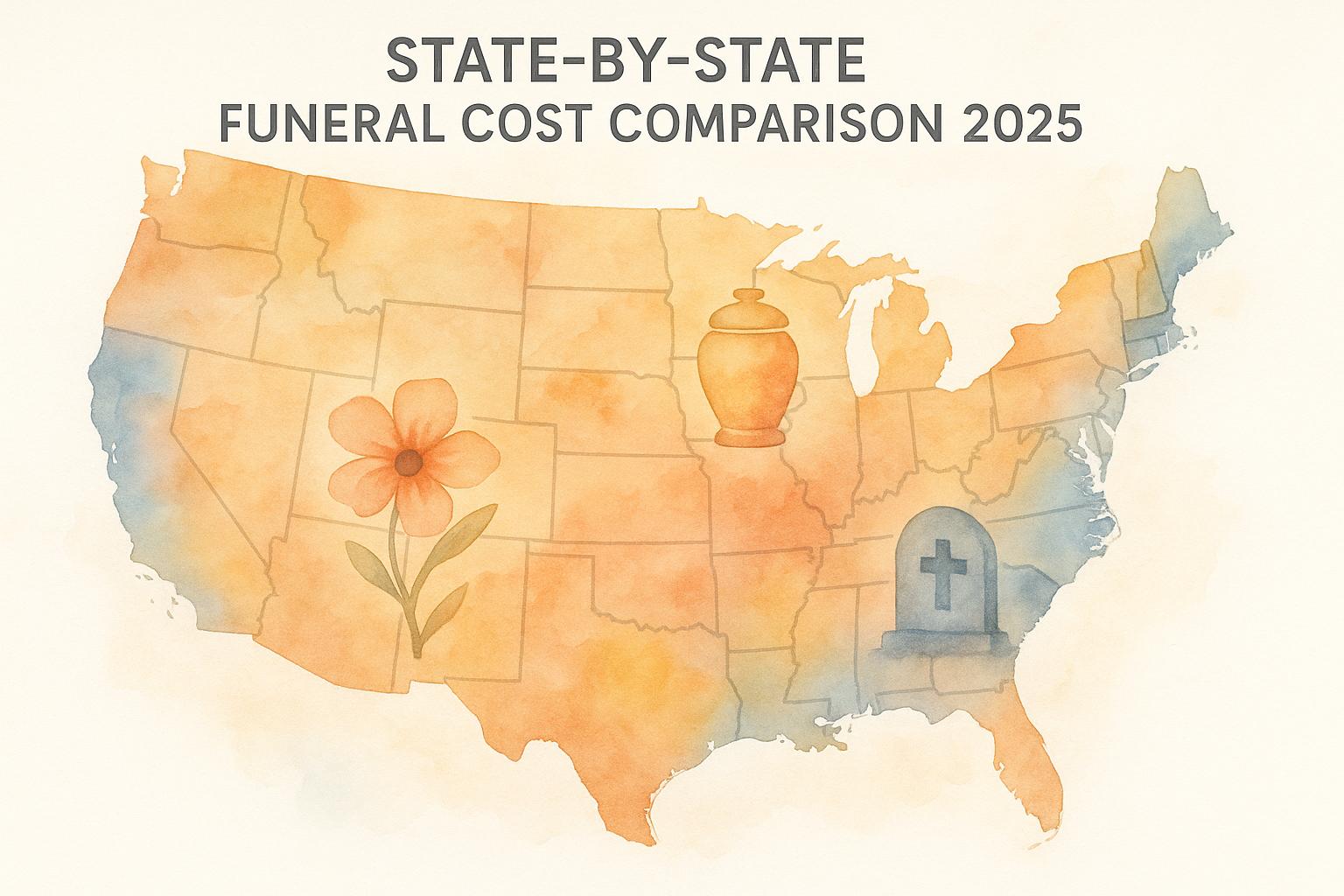
Planning a funeral in 2025 comes with wide-ranging costs depending on location and service type. Burial expenses average $7,000–$12,000, while cremation is generally cheaper, ranging from $4,000–$7,000. Coastal and urban states like Hawaii, California, and New York often exceed $20,000, while Southern and Midwestern states like Mississippi and Arkansas are more affordable. Cremation is gaining popularity, with rates projected to hit 80% by 2045, due to its lower cost and flexibility.
Key findings:
- Burial Costs: Highest in New England ($8,985 median) and lowest in the Mountain region ($7,390 median). Urban areas drive up costs.
- Cremation Costs: New England averages $7,023, while the Mountain region is the least expensive at $5,505.
- Cost Breakdown: Caskets average $2,448, burial plots $2,652, and cremation urns start at $286.
- Ways to Save: Direct cremation, third-party caskets or urns, and pre-planning can significantly reduce expenses.
Funeral costs are rising due to inflation and operational expenses, making it essential to compare prices and explore financial assistance programs like Medicaid, VA benefits, or Social Security death benefits.
Burial, Cremation & Final Expenses: How Much Do They Really Cost?
1. Burial Costs
Traditional burials are often the most expensive option, with costs varying widely depending on location. Understanding these regional differences and the factors that influence burial expenses can help you plan more effectively and potentially save money.
Regional Variations
Where you live plays a big role in burial costs. For instance, the New England region has a median burial cost of $8,985, making it the priciest in the country. On the other hand, the Mountain region – which includes states like Arizona, Colorado, and Utah – offers a more affordable median cost of $7,390, creating a notable difference of $1,595.
In California, burial costs are among the highest, ranging from $10,000 to $15,000, largely due to expensive real estate in cities like Los Angeles and San Francisco. New York follows closely, with costs between $9,500 and $14,000, while Hawaii also ranks high because of limited land availability and higher material shipping costs.
By contrast, Southern and Midwestern states tend to be more budget-friendly. States like Mississippi, Arkansas, Alabama, Oklahoma, and West Virginia report some of the lowest burial expenses. Kansas averages around $6,808, and states like Missouri, Tennessee, and Kentucky also offer below-average costs, thanks to lower living expenses, ample cemetery land, and reduced overhead.
Even within a single state, costs can vary significantly between urban and rural areas. For example, in Texas, burial expenses in cities like Dallas and Houston often exceed the state’s general range of $7,000 to $11,000, driven by higher real estate and labor costs.
State-specific data further illustrates these disparities. Minnesota has the highest state average at $9,697, while Oregon averages $7,533, creating a gap of over $2,000. Florida typically falls in the middle, with costs between $7,000 and $10,000, while Michigan averages around $8,000. Nationwide, the median cost for a funeral with viewing and burial is projected to reach $8,300 by 2025.
Cost Components
A traditional burial with a viewing and ceremony involves multiple expenses that can quickly add up. On average, the total cost for a burial with a vault and funeral services is about $8,930, broken down into the following components:
- Casket: Often the most expensive item, with prices starting at $2,448 and increasing significantly for premium materials.
- Vault or Grave Liner: Costs at least $1,326 and is often required by cemeteries to protect the casket and maintain the grounds.
- Grave Plots and Headstones: Start at $2,652, with urban cemeteries typically charging far more than rural ones.
- Embalming: Ranges from $714 to $1,836. While not legally required in most cases, embalming is necessary for transporting remains across state lines or delaying burial.
- Body Preparation: Adds about $255 for basic services like dressing and casketing.
- Facility Fees: Average $510 for funeral home use during the service and $428 for viewing.
- Hearse Rental: Costs approximately $281.
When combined, these costs typically fall within the national range of $7,000 to $12,000, though premium options can push the total above $20,000 in high-cost markets.
Savings Potential
Despite the high costs, there are ways to reduce expenses:
- Choosing a direct burial eliminates embalming, viewing, and ceremony costs, saving thousands.
- Opting for a less expensive casket can provide immediate savings. Funeral homes are legally required to accept caskets purchased from third-party retailers, giving you the flexibility to shop for better deals.
- Using a grave liner instead of a full vault can save over $1,000, depending on cemetery requirements.
- Exploring cemeteries in more affordable areas, even within the same region, can lower plot and maintenance fees.
- Reviewing itemized price lists, as required by the Funeral Rule, can help you identify the best options.
Financial assistance programs can also help ease the burden. For example:
- Medicaid burial assistance varies by state, offering $520 in Michigan and up to $900 in Rhode Island.
- The Department of Veterans Affairs provides up to $2,000 for eligible veterans.
- Social Security offers a one-time death benefit of $255 to surviving spouses or eligible children.
- Some states have crime victim compensation programs to assist families affected by violent crimes.
Additionally, pre-planning and pre-paying for burial services can lock in current prices, helping you avoid future price hikes due to inflation. This approach can be a smart way to manage long-term costs.
Next, we’ll look at cremation costs, which are a more economical option across all states.
2. Cremation Costs
Cremation is increasingly becoming the choice for most American families. According to the National Funeral Directors Association (NFDA), cremation rates are expected to surpass 80% by 2045, largely due to the cost savings it offers compared to traditional burials. On average, cremation costs range from $4,000 to $7,000, with a median expense of about $6,280 – a savings of roughly $2,545 to $5,000 compared to burial services. Below, we’ll explore how cremation costs vary by region, the key components of these costs, and ways to save.
Regional Variations
Cremation pricing can vary based on geography, though the differences are generally less pronounced than those for burial services.
The Mountain region – including states like Arizona, Colorado, and Utah – has the lowest median cremation costs at $5,505. In contrast, New England is the most expensive region, with a median cost of $7,023, driven by higher facility and operational expenses in states such as Connecticut and Massachusetts.
Hawaii ranks as the most expensive state for cremation, with ceremony fees alone averaging $1,078, followed by Alaska at $740 and Connecticut at $720. These elevated costs often stem from limited land availability, higher shipping fees, and increased labor costs.
On the other hand, the South offers the most budget-friendly options. Mississippi has the lowest ceremony costs at $390, with South Carolina and Louisiana following at $437 and $448, respectively. States like West Virginia, Tennessee, Arizona, and Arkansas also provide affordable cremation services due to lower living costs.
While the cost difference between the most and least expensive states is about $688, this gap is far smaller than the $1,595 disparity seen with burial costs, making cremation a more consistent option nationwide.
Cost Components
The total cost of cremation, especially when it includes a viewing and funeral service, typically averages $6,385. Breaking down these costs can help families identify areas to adjust based on their budget.
- Embalming and preparation: If a viewing is part of the service, embalming may be required, adding up to $2,091.
- Cremation urns: Prices for urns can range from $286 to $5,100, depending on the material and level of customization. Options range from simple, practical designs to more elaborate memorial pieces.
- Facility fees: These are usually included in the total cost. Families opting for direct cremation without a ceremony can often avoid these fees entirely. Additional administrative charges may apply.
To manage costs effectively, always request an itemized price list. This ensures transparency and helps you avoid paying for services you don’t need.
Savings Potential
There are several ways to reduce cremation expenses while still honoring your loved one.
- Direct cremation: This option skips embalming, viewing, and ceremony costs, bringing the total expense closer to the lower end of the $4,000–$5,000 range.
- Price comparison: Funeral homes within the same city can charge vastly different prices for identical services. The Funeral Rule requires providers to offer itemized price lists, making it easier to shop around.
- Third-party urns: Purchasing an urn from an independent vendor instead of a funeral home can save hundreds of dollars. Funeral homes must accept urns purchased elsewhere, giving families the freedom to find more affordable options.
- Pre-planning: Locking in today’s rates by pre-paying for cremation services can shield families from rising costs due to inflation. This provides both financial predictability and peace of mind.
- Financial assistance: Programs like Medicaid burial assistance and benefits from the Department of Veterans Affairs can help offset costs. For example, Michigan offers $145 for cremation services, while Rhode Island provides up to $900. Veterans may qualify for up to $2,000 in burial allowances, and Social Security offers a one-time death payment of $255 to eligible survivors. Some states also have crime victim compensation programs for families affected by violent crimes.
As cremation continues to grow in popularity, its affordability and flexibility make it an appealing option for families seeking meaningful yet cost-conscious ways to honor their loved ones. With rates projected to climb steadily in the coming decades, cremation remains a practical choice for end-of-life arrangements.
sbb-itb-cfbc7e6
Pros and Cons
When deciding between burial and cremation, there’s more to consider than just the costs. While cremation can save families between $2,000 and $5,000 on average, the choice often hinges on personal values, religious beliefs, environmental concerns, and long-term priorities. Beyond the financial differences, here’s a closer look at other factors that may shape your decision.
Financial Considerations
Burial typically comes with a higher price tag than cremation. Beyond the initial costs, burial often involves ongoing expenses like headstone maintenance and cemetery fees, which can range from $50 to several hundred dollars annually.
Cremation, on the other hand, offers a more cost-effective option. With no need for a burial plot or recurring maintenance fees, families can avoid additional long-term expenses. Scattering ashes or keeping them in an urn eliminates the need for further upkeep, making cremation a practical choice for those mindful of future costs.
Cultural and Religious Factors
Cultural and religious beliefs play a pivotal role in the decision between burial and cremation. Many traditions – such as Christian, Jewish, and Islamic faiths – favor or even mandate burial. For families with strong religious convictions, burial may feel like the only appropriate choice, regardless of financial considerations.
Meanwhile, cremation has gained broader acceptance in recent years, though it remains discouraged or prohibited by certain faiths. For many individuals, these deeply personal and cultural factors often take precedence over cost or environmental concerns.
Environmental Impact
Environmental concerns are becoming an increasingly important part of end-of-life planning. Burial requires significant land use and involves materials and processes – like embalming and casket production – that consume resources and energy. Additionally, embalming chemicals can pose risks to groundwater over time.
Cremation, while avoiding the need for embalming and land use, does have its own environmental footprint. The process consumes fuel and releases emissions, though it’s often seen as a less resource-intensive option compared to traditional burial.
Memorialization and Accessibility
Burial provides a permanent, physical location for remembrance, which can be comforting for families seeking a place to visit and honor their loved ones for generations. However, cremation offers unmatched flexibility. Memorial services can be held anywhere, at any time, allowing families to tailor ceremonies to their needs. Cremated remains can be scattered in meaningful locations, divided among family members, or stored in an urn at home, offering options that are not tied to a specific location.
Practical Comparison
| Factor | Burial | Cremation |
|---|---|---|
| Initial Investment | Higher upfront costs | Lower upfront costs |
| Long-Term Expenses | Maintenance and cemetery fees | Minimal to none |
| Permanence | Fixed grave site for future generations | Portable; ashes can be scattered or stored |
| Religious Acceptance | Preferred or required by many faiths | Accepted by some; discouraged by others |
| Environmental Impact | Requires land and embalming chemicals | Fuel consumption but minimal land use |
| Memorialization | Permanent site for visits | Flexible timing and location |
| Service Timing | Typically held within days of passing | Can be arranged later |
| Geographic Flexibility | Tied to cemetery location | Easily transportable remains |
Regional Accessibility
Geography also plays a role in burial and cremation decisions. In densely populated or coastal states like New York and California, limited land availability drives up burial costs. Urban areas often face space shortages, leading families to purchase plots farther from home. Rural regions may offer more affordable burial options but often have fewer funeral service providers.
Cremation costs, by contrast, are more consistent across the country. The price gap between the most and least expensive states for cremation is about $688, compared to $1,595 for burial. This consistency makes cremation a more predictable choice in terms of pricing, regardless of location.
Decision-Making Factors
Choosing between burial and cremation often comes down to personal priorities. For some, the permanence and ceremony of burial resonate deeply, while others may lean toward cremation for its flexibility and reduced environmental impact. Family dynamics also play a part – some families value having a central location to gather, while others appreciate the freedom to memorialize loved ones in different ways, especially when relatives live far apart.
The growing preference for cremation reflects shifting attitudes. With cremation rates projected to reach 80% by 2045, compared to about 60% today, it’s clear that more people are embracing this option. However, both burial and cremation offer distinct benefits, and the right choice will depend on your family’s cultural values, financial situation, and personal preferences.
For more information on navigating these choices, resources like in-Valhalla (https://in-valhalla.com) provide detailed insights into casket types, cremation services, headstone options, and funeral arrangements to help families make informed decisions during challenging times.
Conclusion
Funeral expenses in 2025 show significant variation across regions, influenced by factors like location, real estate costs, and competition. Here’s a quick look at the key takeaways:
The New England region tops the charts with average costs of $8,985 for burial and $7,023 for cremation, while the Mountain region offers the least expensive options at $7,390 for burial and $5,505 for cremation – a difference of $1,595 for burial services. Coastal states like Hawaii, California, New York, and Massachusetts face higher expenses due to urban and real estate pressures. In contrast, states such as Mississippi, Arkansas, Alabama, Oklahoma, and West Virginia benefit from lower costs driven by reduced overhead and stronger competition among providers.
On a national level, cremation costs average $6,280, significantly lower than the $9,995 associated with traditional burials, offering families potential savings of around $3,715. With cremation rates exceeding 60% today and expected to climb to 80% by 2045, it’s becoming an increasingly popular and budget-friendly choice.
For those looking to manage costs, direct cremation – offering no viewing or ceremony – is the most economical option. Families in high-cost regions might consider nearby rural areas or states with more competitive pricing. Additionally, state financial assistance programs, including Medicaid funeral benefits, and resources for veterans through the Department of Veterans Affairs, can help ease financial burdens.
Pre-planning remains a smart strategy for locking in current rates before inflation and rising costs take hold. Funeral expenses continue to climb due to inflation, fuel prices, and labor costs, making it essential to gather multiple quotes to ensure you’re getting the best value.
For more resources and practical advice on end-of-life planning, visit in-Valhalla (https://in-valhalla.com), a helpful guide for making informed decisions during challenging times.
FAQs
How can I manage and reduce funeral costs, especially in expensive states like California and New York?
Managing funeral expenses in states with high costs can be challenging, but there are sensible ways to ease the financial burden while still paying tribute to your loved one. One option to explore is cremation, which is generally less expensive than a traditional burial. Another smart step is to compare prices at different funeral homes in your area – costs can vary widely, even in the same neighborhood.
You might also consider purchasing a casket or urn online, as this can often be more budget-friendly than buying directly from a funeral home. Opting for simpler services, like direct cremation or immediate burial, can further help lower expenses. Pre-planning and having conversations about arrangements ahead of time can prevent last-minute decisions and help you stick to a budget.
How do cultural and religious beliefs shape the decision between burial and cremation, and what should families keep in mind?
Cultural and religious beliefs heavily influence the choice between burial and cremation. For instance, faiths like Judaism and Islam typically lean toward burial, while Hinduism often embraces cremation as part of its practices. Beyond religion, cultural customs and family traditions also play a significant role in shaping these decisions.
When deciding, families should reflect on their religious customs, personal values, and any specific wishes the deceased may have shared. At the same time, practical factors – such as costs and local regulations – should be considered to ensure the arrangements honor both the beliefs and the circumstances at hand.
What financial assistance options are available to help cover funeral costs, and how can families apply?
Several programs can ease the burden of funeral expenses for families. Social Security, for instance, offers a one-time death benefit of $255 to qualifying surviving spouses or children. Similarly, Veterans Affairs (VA) provides burial allowances for eligible veterans, which can help offset costs related to funerals, burials, or cremations.
State and local government programs may also extend support to low-income families. To tap into these resources, you’ll need to contact the appropriate agency – such as the Social Security Administration or your local VA office – and ensure you provide all necessary paperwork, like death certificates and proof of eligibility. In some cases, nonprofit organizations might also extend a helping hand.