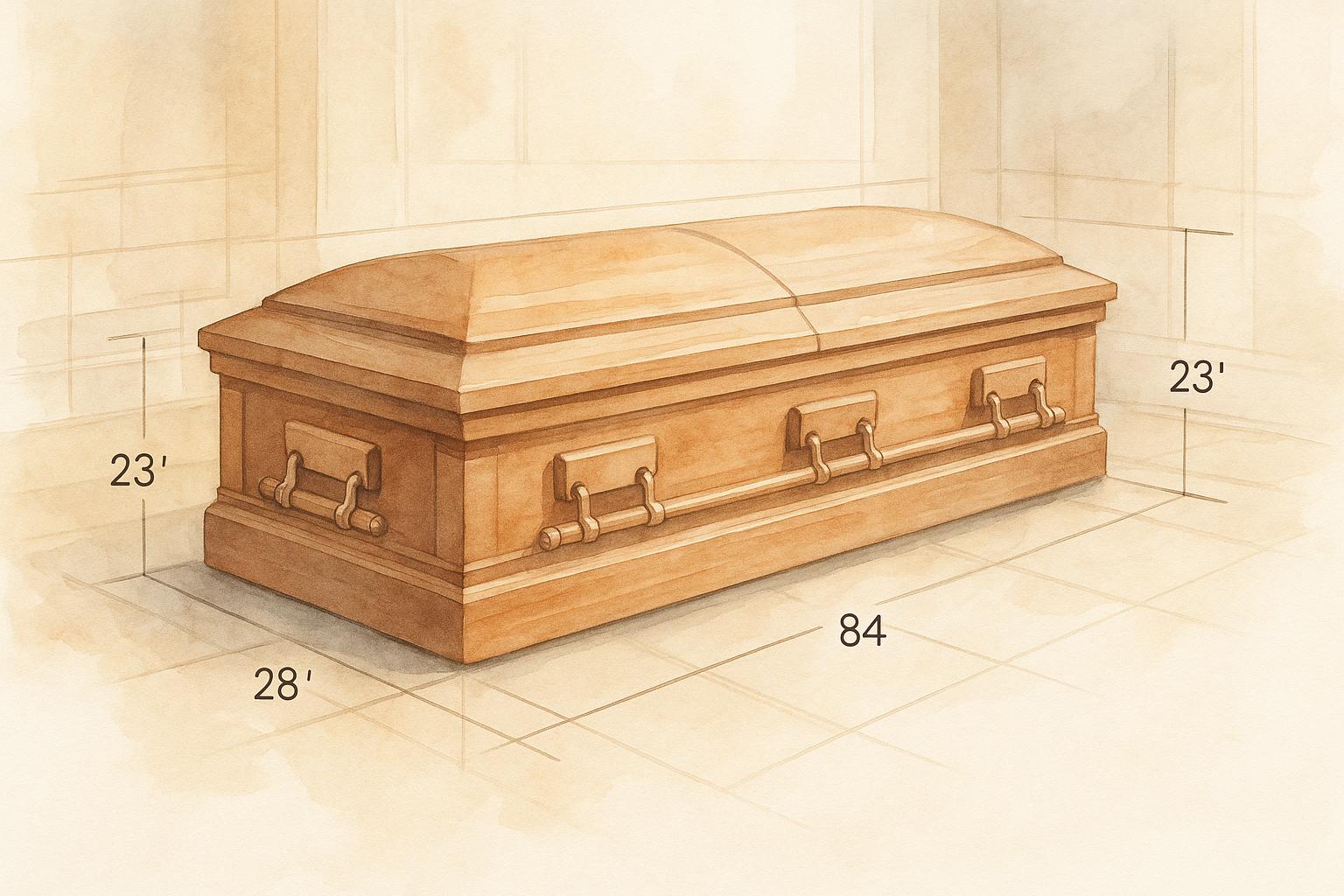
When choosing a casket, size plays a critical role in ensuring proper fit, burial logistics, and cost management. Here’s what you need to know:
- Standard Dimensions: Most caskets in the U.S. measure 84 inches long, 28 inches wide, and 23 inches high externally. They fit adults up to 6’5" and 350 lbs.
- Interior Space: Inside, the dimensions are slightly smaller – 78-79 inches long, 23-24 inches wide, and 14-15 inches high – due to wall thickness and design.
- Oversized Options: For individuals exceeding standard limits, oversized caskets are available, offering widths from 28 to 44 inches and accommodating up to 550+ lbs.
- Burial Vaults and Plots: Standard burial plots are 30 inches wide, and vaults measure 86 x 30 x 24.5 inches internally. Oversized caskets may require custom vaults or additional plots, increasing costs.
- Custom Caskets: For unique needs, custom sizes and designs are available but come with higher costs and longer lead times.
Key Considerations:
- Measurements: Confirm height, width, and weight to select the correct size.
- Costs: Oversized caskets and vaults often cost more, and larger burial plots may be needed.
- Cemetery Rules: Check for restrictions on casket dimensions and burial plot compatibility.
Consulting with a funeral director ensures a proper fit and helps navigate logistics, costs, and cemetery requirements.
What is the Standard Size of a Casket? Just Give Me 2 Minutes
Standard Casket Dimensions in the United States
In the United States, caskets adhere to standardized dimensions that align with industry norms, helping ensure compatibility with burial plots and vaults. These measurements are designed to accommodate the average adult and streamline funeral planning, regardless of whether you choose a wood or metal casket.
Exterior Dimensions
The exterior dimensions of standard caskets are 84 inches long, 28 inches wide, and 23 inches high. These measurements are consistent across the industry and fit comfortably within the typical 30-inch-wide burial plots. This standardization eliminates the need for special adjustments during burial and simplifies cemetery operations.
To protect the casket and maintain the integrity of the grave, cemeteries use burial vaults. Standard vaults measure approximately 86 inches long, 30 inches wide, and 24.5 inches high. These vaults act as protective outer containers, preventing the grave from sinking as the ground settles over time.
| Component | Length | Width | Height/Depth |
|---|---|---|---|
| Standard Casket (Exterior) | 84 inches | 28 inches | 23 inches |
| Standard Burial Vault | 86 inches | 30 inches | 24.5 inches |
| Standard Burial Plot | 96 inches | 30 inches | Varies |
The compatibility between caskets, vaults, and burial plots ensures smooth cemetery operations and minimizes complications during the burial process.
Interior Dimensions
The interior dimensions of a standard casket determine the usable space for the deceased. Typically, the interior measures 78-79 inches in length, 23-24 inches in width, and 14-15 inches in height. These measurements are slightly smaller than the exterior due to the thickness of the casket walls and decorative elements, which reduce the width by about 0.25 inches on each side.
These dimensions are designed to accommodate most adults, including individuals up to 6 feet 5 inches tall and weighing as much as 350 pounds. For taller individuals, minor adjustments, like bending the knees, can help ensure a proper fit.
The interior height of 14-15 inches provides enough vertical space for the deceased while maintaining the structural integrity of the casket. This depth ensures the casket lid can close properly, offering a secure and respectful presentation.
While manufacturers may have slight variations in interior dimensions due to differences in construction methods, these differences are minimal and typically do not impact the casket’s ability to accommodate individuals within the standard size range. Most manufacturers adhere closely to these industry standards to ensure compatibility with burial vaults and cemetery requirements.
Oversized Caskets: When and Why They Are Needed
While standard caskets meet the needs of most individuals, there are cases where larger options are necessary. Oversized caskets are specifically designed to provide the extra space required for individuals who exceed typical dimensions, ensuring a dignified and respectful presentation.
Oversized Casket Dimensions
Oversized caskets generally retain the industry-standard length of 84 inches but offer greater width and depth compared to standard models. These widths range from 28 to 44 inches, with the most common sizes being 28, 29, 33, 40, and 44 inches. Depths also increase, with oversized caskets reaching up to 27 inches, compared to the standard depth of 23 inches. These adjustments ensure a better fit for larger individuals.
It’s worth noting that the interior of an oversized casket is slightly smaller than its exterior. For instance, a casket with a 36-inch-wide exterior will typically have an interior width of about 35.75 inches.
| Casket Width | Length | Depth | Weight Capacity | Typical Height Range |
|---|---|---|---|---|
| 28" (Standard) | 84" | 23" | Up to 350 lbs | Up to 6’5" |
| 28" (Oversized) | 84" | 23" | Up to 450 lbs | Around 6’10" |
| 36" (Oversized) | 84" | 27" | Up to 550 lbs | Larger frame individuals |
| 40-44" (Oversized) | 84-90" | 27-30" | 550+ lbs | Exceptionally large individuals |
The range of widths ensures flexibility to accommodate various body types.
Common Use Cases for Oversized Caskets
Oversized caskets are primarily chosen for individuals whose height or weight exceeds the capacity of standard caskets. For example, a 28-inch oversized casket can accommodate someone up to 6 feet 10 inches tall and 450 pounds, while a 36-inch model is suitable for individuals weighing up to 550 pounds. For those with even larger dimensions, options like 40- or 44-inch caskets are available.
In addition to physical needs, oversized caskets may also be selected for specific funeral traditions or unique circumstances. For instance, companion caskets or ceremonial requirements might necessitate custom-made metal caskets with expanded dimensions.
Caskets under 30 inches in width generally fit into standard burial vaults, which measure 86 inches long, 30 inches wide, and 24.5 inches high. However, caskets wider than 33 inches require oversized burial vaults and often larger or additional burial plots. This can have a noticeable impact on logistics and costs.
Funeral directors play a key role in determining whether an oversized casket is needed. They assess the deceased’s height and weight, as well as vault and plot requirements, to guide families through the process. Thankfully, oversized caskets are widely available today and come in both wood and metal options. The choice between materials often depends on personal preferences, budget, and aesthetic considerations, as size does not affect functionality.
sbb-itb-cfbc7e6
Custom Casket Sizing: Tailored Solutions for Specific Needs
When even oversized caskets are not sufficient, custom caskets provide a way to address unique requirements. These specialized options allow families to honor their loved ones in a manner that standard sizes simply cannot accommodate.
When Custom Caskets Are Needed
There are specific situations where custom caskets become essential. For example, companion caskets are designed to hold two individuals, often chosen by couples wishing to be interred together or for specific ceremonial purposes. In other cases, individuals with unique medical conditions, prosthetics, or mobility devices may require caskets with customized internal layouts to accommodate their needs.
Religious or spiritual practices may also call for custom designs. Certain traditions require specific materials, construction methods, or interior linings that standard caskets do not offer. Customization ensures these traditions are respected.
Personalization is another reason families turn to custom caskets. This could involve adding specialized artwork, engravings, or unique material combinations that reflect the deceased’s personality, life achievements, or profession.
For individuals whose dimensions exceed even oversized caskets – such as those taller than 6’6" or significantly heavier than the standard capacity – custom caskets are often the only option. Custom metal caskets, for instance, can exceed the typical maximum dimensions of 84 inches in length and 44 inches in width.
Cemetery regulations can also influence the need for custom caskets. Caskets wider than 30 inches may require oversized burial vaults or even additional burial plots. Families should confirm these regulations with the cemetery before finalizing custom specifications.
These unique needs naturally lead to understanding the process of ordering a custom casket.
The Custom Casket Ordering Process
Once a family identifies the need for a custom casket, the ordering process begins. Funeral directors serve as the key point of contact, working closely with manufacturers to ensure all requirements are met.
The process starts with a detailed consultation. During this discussion, families outline their needs, including dimensions, materials, religious or spiritual preferences, and any desired personalization. The funeral director then translates these details into technical specifications for the manufacturer.
Accurate measurements are critical to prevent delays. Funeral directors will gather precise length, width, and depth measurements of the deceased. For companion caskets or other specialized designs, additional details – such as religious practices, material preferences, and interior configurations – are necessary.
Timing is another important factor. Families should communicate the need for a custom casket as early as possible, ideally when funeral arrangements are first made. This allows time for specification reviews, material sourcing, manufacturing, and delivery.
Custom caskets come with a wide array of material and design options. Beyond traditional wood and metal, families can choose exotic woods, alternative metals, eco-friendly materials, or hybrid designs. Interiors can also be tailored with unique linings, cushioning, or personalized embellishments.
Costs for custom caskets are typically higher than standard options, reflecting the specialized nature of the work. Pricing depends on factors like material choices, design complexity, size, and customization details. Families should discuss costs thoroughly with their funeral director to align expectations before finalizing any decisions.
Throughout the process, open communication with the funeral director is key. They can provide insights into manufacturers, typical costs, and realistic timelines. They also manage quality control and coordinate delivery to ensure everything arrives on time.
Families should weigh their customization preferences against practical considerations like budget and timing. It’s important to prioritize essential needs and be open to alternatives if certain customizations aren’t feasible. A standard or oversized casket with minor modifications may sometimes achieve the desired result while saving time and money. Your funeral director can guide you in finding the best balance between personalization and practicality.
How to Choose the Right Casket Size
Picking the right casket size requires accurate measurements and open communication with funeral professionals to ensure the best fit for your loved one.
How to Measure for a Casket
To determine the appropriate casket size, focus on three main measurements: height, width, and weight. These will help you decide between a standard or oversized casket.
- Height: Measure from the top of the head to the heels. Standard caskets are designed for individuals up to about 6 feet 5 inches tall. For those up to 6 feet 10 inches, adjustments like bending the knees during placement may work. If the individual is taller, oversized caskets, which range from 84 to 90 inches in length, may be necessary.
- Width: Measure the broadest part of the shoulders and torso. Standard caskets typically have a 24-inch interior width, suitable for most adults. For those who are larger, caskets with a 28-inch width can accommodate individuals up to 6 feet 10 inches tall and around 450 pounds. Oversized options, with widths between 33 and 36 inches, can support individuals weighing up to 550 pounds.
- Weight: Standard caskets generally hold up to 350 pounds. For individuals exceeding this weight, oversized caskets with higher weight capacities are available.
Funeral directors can confirm these measurements and provide guidance on the right casket size. Sharing details like health conditions, prosthetics, or other physical factors can help ensure a proper recommendation. These measurements serve as a starting point for discussions with funeral professionals.
Factors Beyond Dimensions
While physical measurements are crucial, other practical considerations also play a role in selecting the right casket.
Budget: Oversized caskets often cost more, and they may require oversized burial vaults, which add to the overall expense. Additionally, caskets wider than 33 inches could necessitate a second or larger burial plot. Discussing these costs early can help avoid surprises.
Cemetery Regulations: Many cemeteries have specific rules about casket sizes. Standard burial plots are usually 30 inches wide, accommodating most standard and some slightly oversized caskets. Wider caskets may require special arrangements, so verifying plot dimensions and restrictions is essential.
Burial Vault Compatibility: Standard burial vaults typically measure 86 inches long, 30 inches wide, and 24.5 inches high internally. Caskets with exterior widths under 30 inches generally fit these vaults, but wider caskets will need oversized vaults, which can be significantly more expensive.
Material and Style: Not all casket styles are available in every size. While wood and metal caskets often have similar exterior dimensions, their interior measurements can vary slightly. Balancing aesthetic preferences with size requirements may involve some compromise.
Religious and Cultural Practices: Certain traditions may specify requirements for materials, construction, or interior linings, which could affect the size and type of casket available. Families should consider these practices to ensure the casket aligns with their values and needs.
After confirming the physical dimensions, weigh factors like cost, cemetery rules, and material preferences to make an informed decision.
Questions to Ask Funeral Professionals
Open communication with funeral professionals can help address any concerns and ensure all needs are met. Here are some questions to consider:
- Will a standard casket fit my loved one comfortably, or do we need an oversized option?
- What are the interior dimensions of the caskets you recommend, and how do they compare to my loved one’s measurements?
- If we choose an oversized casket, will it fit in a standard burial vault, or will we need a larger one?
- What additional costs should we expect for oversized caskets or vault modifications?
- Are there any cemetery or burial plot restrictions we should be aware of?
- Can you explain the difference between exterior and interior dimensions and why they matter?
- What customization options are available if standard choices don’t meet our needs?
Funeral professionals should provide clear and compassionate guidance during these discussions. Visual aids like dimension charts or sample caskets can make it easier to understand the options. Families should feel comfortable asking for clarification to ensure the final decision honors their loved one while staying within practical and financial boundaries.
Conclusion
Choosing the right casket size involves a thoughtful balance of dignity, proper fit, and practical considerations. Standard caskets are designed to accommodate most adults up to about 6 feet 5 inches tall and 350 pounds, fitting within the typical 30-inch-wide burial plots and standard vaults. It’s important to remember that the interior dimensions of caskets are slightly smaller than their exterior measurements due to construction and hardware, which can affect the fit.
For those who exceed standard size parameters, oversized caskets – ranging from 28 to 44 inches in width – provide an alternative. However, caskets wider than 33 inches often require oversized burial plots and vaults, which can lead to higher costs. This connection between casket dimensions and burial logistics underscores the importance of planning ahead and consulting with funeral professionals.
Funeral directors play a key role in guiding families through this process. Their expertise in measurements, cemetery regulations, and available options helps ensure compatibility with vaults and burial plots, while also addressing any cost differences. With their support, families can make informed decisions during an emotionally challenging time.
FAQs
What should I consider when choosing between a standard and an oversized casket?
When choosing between a standard and an oversized casket, there are a few important considerations to weigh. Standard caskets are generally about 28 inches wide and 84 inches long, providing a size that suits most individuals. However, if more room is required for comfort or personal reasons, oversized caskets are an option, often measuring up to 36 inches wide or even larger.
Key factors to think about include the individual’s size, the dimensions of the burial space, and any specific guidelines from the cemetery or funeral home. Additionally, personal preferences – like the choice of materials or design – can differ between standard and oversized models. Discussing these details with a funeral professional can help you make the right choice for your circumstances.
How do cemetery rules affect the size of caskets and burial plots?
Cemetery regulations significantly influence the size of caskets and burial plots. These rules are in place to ensure that caskets fit securely within the allotted space and comply with any specific standards the cemetery may have.
It’s crucial to contact the cemetery before choosing a casket or plot to familiarize yourself with their requirements. This step can help prevent potential issues and make the process less stressful during an emotionally challenging time.
What is the difference between standard and custom caskets, and when should you consider a custom option?
Standard caskets are pre-made with commonly used dimensions and designs, making them suitable for most individuals. They’re typically crafted from materials like wood, metal, or fiberglass and come in various finishes and styles. These options are often more budget-friendly and easy to find.
Custom caskets, however, are designed to meet specific preferences or requirements. They’re ideal for those needing non-standard sizes, unique designs, or personalized touches like engravings or specific materials. This option provides a way to create a more individual and meaningful tribute.
A custom casket might be the right choice if standard options don’t fit your needs or if you’re looking for something more distinctive to honor a loved one.