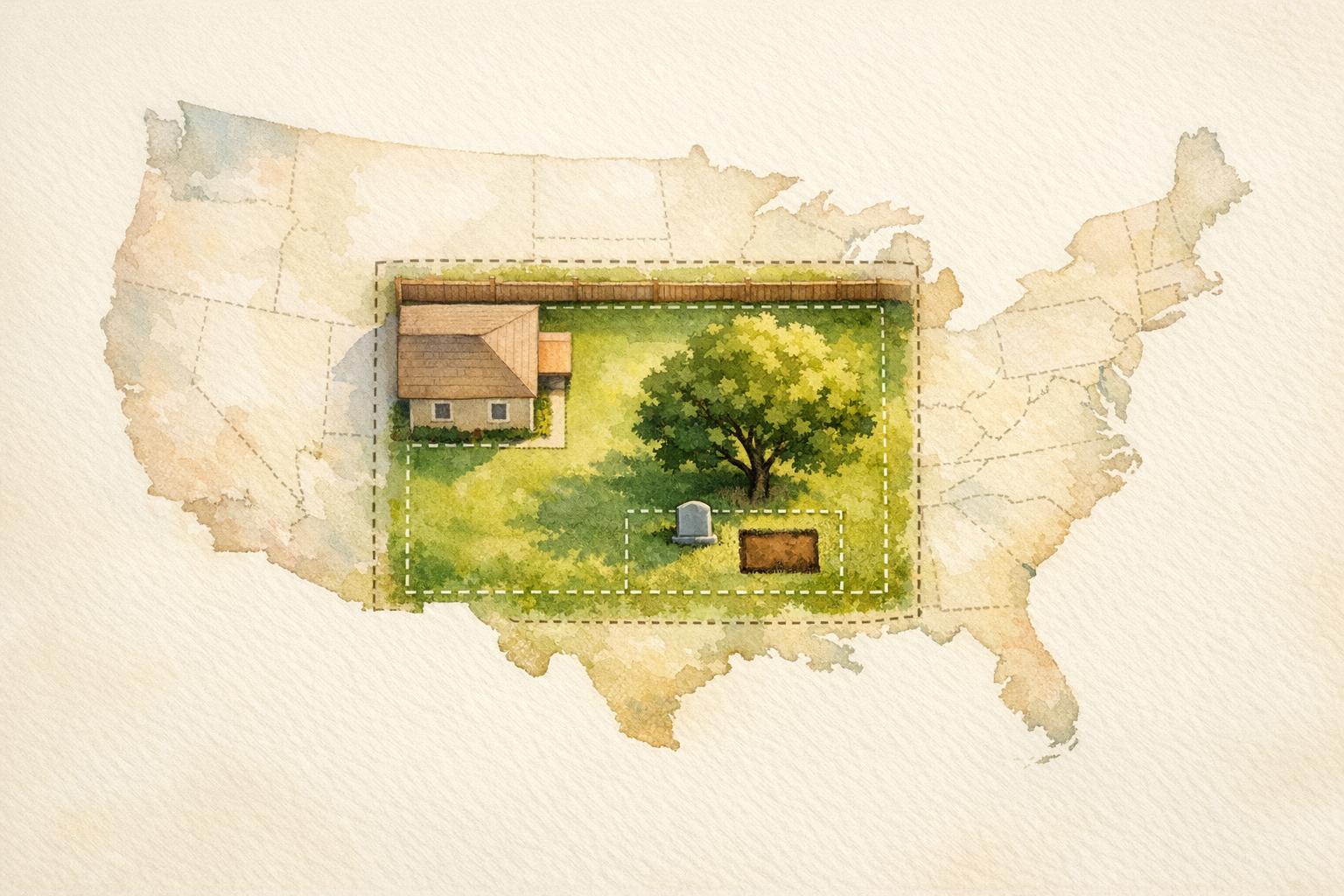
Backyard burials are allowed in most U.S. states, but rules vary significantly. Some states, like California and Washington, have strict regulations requiring burials in established cemeteries, while others, like Georgia and Kentucky, permit burials on private land with local approvals. Key points to consider include:
- State laws: Some states outright ban private burials or require special permits.
- Local zoning rules: Even if state laws allow it, local ordinances may impose setbacks from property lines, water sources, or buildings.
- Funeral director requirements: States like Illinois mandate a licensed funeral director, while others do not.
- Burial depths and preservation: Depth requirements range from 18 inches to 3 feet, and embalming is often unnecessary unless transporting the body.
Cost savings and personal preferences often drive interest in home burials, but compliance with state and local laws is essential. Always confirm regulations with local authorities to avoid legal issues.
1. California
Legality
In California, backyard burials on private property are generally not allowed. Attorney Jeff Burtka clarifies:
"In California, bodies must be buried in established cemeteries. City or county authorities have the authority to establish and regulate burial grounds."
However, in rural areas, it is possible to set up a private family cemetery, but this requires explicit approval from local zoning authorities. You’ll need to consult with your municipal or county department to explore this option. Matt Woodcheke, spokesperson for the California Department of Consumer Affairs, emphasizes:
"Obtaining licensure from the Bureau is a required step in establishing a cemetery… any privately owned cemetery is subject to the laws under the Cemetery and Funeral Act. This includes family cemeteries that are not open to the public."
If you’re considering a burial on private land, your first step should be contacting your local zoning department to confirm whether your property qualifies for designation as a family cemetery. Additionally, California law mandates filing a death certificate with the local registrar within eight days of the death and before any burial. Each certified copy of the death certificate costs $24.
These legal requirements form the foundation for handling burials in the state.
Funeral Director Required
When it comes to burial arrangements, California law does not require a licensed funeral director for home funerals or burials. The next of kin or a designated agent can handle the arrangements themselves. However, approval from local authorities is still necessary due to cemetery regulations.
Zoning and Distance Requirements
Zoning laws in California add another layer of regulation. State rules require burials to be at least 18 inches deep. In rare cases, like extreme hardship or double burials, the minimum depth may be reduced to 12 inches. For green burials, additional care must be taken to ensure the site is at least 100 feet away from any water source.
Preservation Rules
If a burial or disposition occurs more than 24 hours after death, the body must be embalmed or refrigerated, unless it’s part of a home funeral. Embalming is only legally required when a body is being transported out of state.
sbb-itb-cfbc7e6
2. Indiana
Legality
Attorney Jeff Burtka explains the legal framework for burials in Indiana:
"In Indiana, bodies must be buried in established cemeteries within a ‘reasonable time after death.’"
In rural areas, landowners have the option to establish private family cemeteries. However, this requires careful adherence to local zoning laws. Steps include reviewing zoning regulations, submitting a detailed site map, and recording the cemetery’s location with the property deed. Additionally, obtaining a burial permit from the local health officer in the county where the death occurred is mandatory. These requirements ensure compliance with both state and local guidelines.
Funeral Director Requirement
Indiana law requires a licensed funeral director to oversee burial arrangements. As Attorney Jeff Burtka highlights:
"By law, a licensed funeral director must oversee the final disposition of a body in Indiana. For example, only a licensed funeral director may be issued a permit to move the body for final disposition."
This means that even if you create a private family cemetery, you cannot independently handle the burial process. The funeral director is responsible for securing the necessary burial permit and ensuring the death certificate is properly filed.
Zoning and Distance Requirements
Local zoning laws play a key role in determining where burials can take place. While Indiana state law does not set specific distance requirements for burial sites in relation to water sources, wells, or property lines, these details are typically governed by county or town ordinances. To avoid complications, it’s crucial to check with your local clerk’s office for any zoning restrictions, which often include minimum distances from roads, easements, or bodies of water.
Preservation Rules
Indiana does not mandate embalming, but burial or cremation must occur without unnecessary delay. For cremations, there is a 48-hour waiting period unless a local health officer grants a waiver. When it comes to scattering cremated remains, this is allowed on private property with the owner’s consent. The ashes must be reduced to a particle size of one-eighth inch or smaller, and a form documenting the disposition must be filed with the county recorder within 10 days. These rules aim to balance personal preferences with regulatory standards.
3. Washington
Legality
Washington State has some of the most stringent rules when it comes to backyard burials. According to attorney Jeff Burtka:
"In Washington, all bodies must be buried in established cemeteries, which must be run by cemetery corporations."
This means you can’t just bury someone on private property without following specific legal steps. To use private land as a burial site, you must officially convert it into a cemetery. This involves surveying, subdividing, mapping the area, and filing a declaration with the county recorder. Once the land is designated as a cemetery, it can only be used for burial purposes. Additionally, state laws dictate that these sites must be at least two miles outside city limits and cannot exceed one acre in size.
Before any burial takes place, you’re required to secure a burial-transit permit from the local registrar in the district where the death occurred. The permit must be signed, filed, and include the burial date and type of disposition, all within 10 days. These rules reflect Washington’s highly regulated approach to burial practices.
Funeral Director Requirement
Even with these strict land dedication requirements, Washington does allow for private handling of final arrangements. The state does not require the involvement of a licensed funeral director. The person legally responsible for the deceased can file the death certificate and oversee the process independently. If you decide to manage these arrangements yourself, reach out to your local health department for guidance on filing a death report and obtaining a burial-transit permit through the state’s electronic system. Keep in mind, each certified copy of the death certificate costs $25.
Preservation Rules
If you opt not to use a funeral director, you’ll be responsible for the body’s preservation until burial. Washington law does not mandate embalming unless the state board of health determines it’s necessary due to a contagious disease. For short-term preservation, refrigeration or dry ice can be used. Be sure to file the death certificate within five days and secure the burial-transit permit within three business days.
4. Georgia
Legality
In Georgia, backyard burials are allowed since there are no state laws explicitly forbidding them. According to Georgia Code § 36-72-1, human remains are considered part of the state’s heritage rather than personal property. This means you can legally bury someone on your property, but the remains are safeguarded as part of Georgia’s historical and cultural legacy. However, local zoning ordinances may impose additional restrictions, so it’s essential to check with your local government for specific requirements.
Funeral Director Required
Georgia does not require the involvement of a licensed funeral director. Instead, a family member or an appointed agent can manage the process, including filing the death certificate. This document must be submitted to the local health department or vital records registrar within 72 hours, and the attending physician or coroner must complete the medical certification within the same timeframe. If you plan to relocate the body, written approval from the medical examiner or attending physician is necessary. For death certificates, the first certified copy costs $25, with an $8 processing fee. Additional copies are available for $5 each.
Zoning and Distance Requirements
While Georgia state law doesn’t dictate specific burial distance requirements, experts suggest maintaining at least 150 feet from water sources and 25 feet from power lines. Local governments can, however, enforce stricter rules. For instance, starting February 2024, Macon-Bibb County will require all human remains to be buried in authorized cemeteries. They also mandate the use of "leak-proof" caskets or vaults, which effectively bans traditional backyard burials in that area. In counties where home burials are permitted, you may need a permit, which often involves a survey by a state-registered land surveyor. Recording the burial site on your property deed is a good practice to assist future property owners. These local variations make it crucial to understand both state and municipal regulations.
Preservation Rules
Embalming is not a requirement in Georgia. Instead, refrigeration or dry ice can be used for body preservation. State law does not mandate the use of caskets, though local ordinances might. These relaxed rules can help families save money, especially since the average burial in Georgia costs over $7,800, while cremations can run up to $3,000.
5. Kentucky
Legality
In Kentucky, backyard burials on private property are allowed, provided you comply with local zoning regulations. State law lets you designate an agent in a written funeral plan to oversee your final arrangements, offering some flexibility. However, it’s crucial to check with your county or town clerk to ensure compliance with local rules, especially if you’re planning to establish a family cemetery. As Attorney Jeff Burtka explains:
"There are no state laws in Kentucky prohibiting home burial, but you should ask your county or town clerk about local zoning rules before burying a body on private land."
Additionally, you’ll need to file a map of the burial site with your property deed.
Funeral Director Required
Kentucky law doesn’t mandate hiring a funeral director. A family member or friend can legally take charge of filing the death certificate and handling burial arrangements. The provisional death certificate doubles as the permit for transporting and burying the body. Once the burial is complete, the person managing the arrangements must sign, date, and re-file the death certificate with the local registrar within five days.
Zoning and Distance Requirements
Burial depth requirements in Kentucky vary depending on the type of container used:
- For hermetically sealed, impervious containers (like those made of concrete, metal, or fiberglass), the burial must be at least 2 feet below the natural ground surface.
- For all other types of containers, the minimum burial depth is 3 feet.
If you encounter bedrock while digging, the local health department can grant a variance to these depth requirements.
| Burial Type | Minimum Depth Requirement |
|---|---|
| Hermetically sealed impervious container (concrete, metal, fiberglass) | 2 feet below natural surface |
| Standard burial (all other containers) | 3 feet below natural surface |
Preservation Rules
Kentucky does not require embalming, making refrigeration or dry ice viable options for temporary preservation. This can be especially practical for natural burials or for reducing costs. While the state doesn’t mandate the use of a casket, keep in mind that individual cemeteries may have their own rules. Kentucky’s lenient approach stands in contrast to stricter regulations in some other states.
6. Maryland
Legality
In Maryland, backyard burials are allowed on private property, as long as local ordinances don’t prohibit them. According to Maryland Code, Health-General, § 5-514, it’s essential to check with your county health department or town clerk to confirm zoning regulations. Maryland law also requires a burial-transit permit before the burial can take place. To obtain this, you must return a death certificate signed by a medical professional to the Secretary of Health within 10 days. These steps ensure the burial process adheres to state requirements.
Funeral Director Required
Interestingly, Maryland law doesn’t mandate the involvement of a licensed funeral director. A family member or friend can handle the responsibilities of a funeral director, provided they are not paid for their services. Attorney Jeff Burtka explains:
"Maryland doesn’t require you to involve a licensed funeral director in making or carrying out final arrangements."
Whoever takes on this role must file the death certificate with the Department of Health within 72 hours of the death. Additionally, the medical certification portion of the death certificate must be completed by a physician, physician assistant, or nurse practitioner within 24 hours of receiving it.
Preservation Rules
Maryland law does not require embalming, offering alternative options like refrigeration or dry ice for temporary preservation. There’s also no legal obligation to use a casket or burial vault for home burials. However, if the deceased had a communicable disease, such as tuberculosis or hepatitis, it’s crucial to consult local health authorities for specific guidelines on handling the body.
7. Massachusetts
Legality
Massachusetts allows home burials, but the process involves multiple layers of approval. To proceed, you’ll need written consent from your local Board of Health (BOH) and your town or city government. The property must be owned or controlled by the deceased’s family, and the burial must be noted on the property deed as an encumbrance before the land can be sold or transferred. This process typically requires submitting a site plan, obtaining a certified soil evaluation, and securing approvals from the BOH, MassDEP, and your municipality.
These steps make Massachusetts’ requirements more intricate compared to states with less stringent regulations.
Funeral Director Required
Families in Massachusetts have the option to act as their own funeral directors. Attorney Jeff Burtka clarifies:
"Massachusetts doesn’t require you to involve a licensed funeral director in making or carrying out final arrangements."
If you choose to handle the arrangements independently, you’ll need to coordinate directly with the medical professional who signs the death certificate, the local city or town clerk, and the burial agent to complete the electronic death certificate. Deaths must also be registered with the local board of health within five days.
Zoning and Distance Requirements
Massachusetts enforces strict zoning rules to safeguard water sources and prevent contamination. Burials must adhere to these setback requirements:
- 300 feet from private wells
- 100 feet from public water sources
- 200 feet from rivers
Additionally, there are slope restrictions (a 3:1 maximum unless a variance is granted) and prohibitions against burials in FEMA-designated flood zones.
Preservation Rules
Embalming is not mandatory, which allows for green burials unless the local BOH prohibits them due to infectious disease concerns. The body must be buried under at least 3 feet of soil and the grave must maintain a 3-foot buffer from the seasonal high groundwater level. Furthermore, removing soil within 4 feet of the historical high groundwater table is not permitted unless specific re-deposition criteria are met.
8. Illinois
Illinois has its own set of rules and guidelines when it comes to home burials, and these can vary depending on local ordinances.
Legality
In Illinois, home burials are allowed on privately owned land, but local regulations may apply. Zoning ordinances might restrict home burials based on factors like land ownership, proximity to neighbors, or environmental concerns. If your burial site qualifies as a family burying ground – used only for immediate family members, under three acres in size, and with no lot sales – it can be fully exempt from the Cemetery Oversight Act without incurring any fees. However, sites unused for more than 10 years also fall under this exemption. Always confirm these specifics with your county or town clerk.
Funeral Director Required
Illinois law requires the involvement of a licensed funeral director for home burials. Attorney Jeff Burtka highlights this requirement:
"Illinois is one of only a handful of states that restrict home funerals by requiring the involvement of a licensed funeral director in many aspects of final arrangements."
The funeral director’s role includes overseeing the final disposition, filing the death certificate within seven days, and securing the necessary permit for disposition. Even if you take on most of the arrangements yourself, this step is mandatory.
Zoning and Distance Requirements
Local zoning laws play a significant role in determining whether a home burial is permitted in Illinois. Since there are no statewide distance requirements, you’ll need to check with your municipality for specific rules. Lauren Liebhaber explains:
"Zoning laws may prohibit home burials if you don’t own the land, if you live in close proximity to your neighbors, or if you intend to bury the person on land that is prone to erosion and run-off."
If zoning regulations allow a backyard burial, you might also need to create and file a map of the burial site with your property deed. This ensures future property owners are informed about the grave’s location.
Preservation Rules
Illinois does not require embalming, making green burials an option. While there’s no state-mandated timeline for burial beyond filing the death certificate within seven days, the law does set a minimum burial depth. Specifically, there must be at least 18 inches of soil covering the top of the body, casket, or vault. Additionally, state law does not mandate the use of a casket, though individual cemeteries may enforce their own container requirements.
Comparing Strict and Lenient State Laws

State-by-State Comparison of Backyard Burial Laws and Requirements
The overview of state regulations reveals a stark divide between strict and lenient approaches to backyard burials. Among the eight states discussed, places like California, Indiana, and Washington enforce strict rules, requiring burials to occur in established cemeteries. On the other hand, states such as Georgia and Kentucky allow private burials, provided families comply with local zoning laws and secure the necessary permits. These differences significantly impact the choices families face, both emotionally and practically.
Lenient laws often appeal to families seeking cost-effective and deeply personal burial options. They allow for ceremonies tailored to individual preferences and provide the opportunity to keep loved ones close. However, families in these states also take on the responsibility for grave maintenance. For instance, digging a grave by hand can take 8 to 10 hours, making the process labor-intensive and time-consuming.
In contrast, stricter regulations emphasize public health and environmental safety. These laws often include specific requirements for burial distances and depths to minimize risks. For example, Massachusetts recommends maintaining a 300-foot setback from private wells. As the Massachusetts Department of Environmental Protection explains:
"The potential for bacteria, viruses, and other microorganisms from human remains to reach groundwater and infect other people appears to be the greatest source of public health concern associated with burials".
Similarly, Georgia mandates burials to be at least 25 feet from state waters and 50 feet from property lines. Burial depth requirements also vary, with Kentucky requiring a 36-inch cover, while Illinois only mandates an 18-inch cover. Interestingly, none of the 50 U.S. states legally require a casket for burial, though individual cemeteries may impose their own container rules.
The table below highlights key regulatory differences across the eight states:
| State | Burial on Private Property | Funeral Director Required? | Key Distance/Depth Rules | Preservation Mandates |
|---|---|---|---|---|
| California | Rarely (special permit) | No (but permits required) | 18-inch cover | Embalm/refrigerate after 24 hours |
| Indiana | Must be an established cemetery | No | 24-inch cover | No embalming requirement |
| Washington | Must be an established cemetery | No | Must meet local zoning rules | Required for common carrier |
| Georgia | Allowed (check zoning) | No | 25′ from water; 50′ from property lines | No embalming requirement |
| Kentucky | Allowed with permit | No | 36-inch cover | No embalming requirement |
| Maryland | Allowed in family plots | No | Subject to local ordinance | No embalming requirement |
| Massachusetts | Allowed with BOH approval | No | 300′ from private wells (recommended) | No embalming requirement |
| Illinois | Allowed with permits | Yes | 18-inch cover | No embalming requirement |
This comparison underscores the balance between personal freedom and public safety, with each state setting its own priorities and standards.
Conclusion
Burial laws for private property differ widely across the United States. States such as California, Indiana, and Washington typically require burials to occur in established cemeteries. On the other hand, states like Georgia and Kentucky allow burials on private land, provided families secure the necessary permits and zoning approvals.
It’s crucial to check local regulations before making burial arrangements. While state laws offer general guidelines, local zoning boards and health departments often enforce stricter rules. Proper documentation is also key to protecting property rights and avoiding future disputes.
As the National Home Funeral Alliance explains:
"Religious observations, family gatherings, memorials, and private events are not under the jurisdiction of the State or professionals in the funeral industry, who have no medico-legal authority unless it is transferred to them when they are paid for service".
That said, this freedom comes with certain responsibilities. Families must ensure compliance with setback requirements, which typically range from 50 to 300 feet from water sources, property lines, and buildings.
Additionally, recording the burial location on the property deed is essential to prevent legal complications down the line. Home burials are often considered an encumbrance on the property, and failing to document them properly can lead to issues during future property transactions.
For detailed information on end-of-life planning, including state-specific burial laws and alternative options, resources like in-Valhalla can provide valuable support during these challenging decisions.
FAQs
What are the legal rules for burying someone in your backyard in the U.S.?
Laws regarding backyard burials in the U.S. differ significantly from state to state. In most cases, you’ll need to adhere to zoning regulations, secure the necessary permits, and meet specific environmental guidelines. For example, states like Texas and Vermont permit backyard burials as long as the proper permits are obtained. On the other hand, states such as California and Indiana have outright bans on the practice.
Even in states where private burials are permitted, there are often additional rules to follow. These might include requirements for burial depth, restrictions on how close the burial site can be to water sources, and the need to maintain accurate records, especially if you ever plan to sell the property. To ensure everything is done legally, it’s essential to research your local laws thoroughly and secure all necessary approvals before proceeding with a backyard burial.
Can I legally bury someone in my backyard, and how do I check local laws?
Backyard burials are subject to local zoning laws and regulations, which can vary widely depending on your location. To find out if this is an option where you live, your first step should be reaching out to your county or town clerk. They can give you the specifics on zoning ordinances, permits, or any restrictions that may apply to your property.
While home burials are allowed in many states, particularly in rural areas, local regulations often come with extra conditions. For instance, some places might require assessments to address environmental concerns or enforce rules about how far the burial site must be from water sources or property lines. Always check with your local government to make sure you’re following the law before making any plans.
What environmental risks should I consider before a backyard burial?
Backyard burials come with some risks, particularly when it comes to groundwater contamination. As bodies decompose, fluids can seep into the surrounding soil, potentially reaching nearby wells or streams. This risk is higher in areas with porous soil or a high water table, where contaminants can travel more freely.
Another issue arises from improper burial practices. Shallow graves or using non-biodegradable materials can disrupt local ecosystems. To address these concerns, many states have regulations in place. These might include requirements for burial depth, the use of biodegradable materials, or even permits and environmental assessments to ensure the site doesn’t pose a threat to the environment. Always review your state’s guidelines to stay compliant and protect the local ecosystem.